


Emergency Hotline:
(+63) 2 911 – 8688


MANILA, Philippines — Nearly six million persons with disability (PWD) identification cards are unaccounted for in government registration figures, raising concerns over the possible widespread use of fraudulent IDs to obtain discounts and other benefits intended for qualified beneficiaries.
The Department of Justice (DOJ) raised the alarm on Thursday, October 8, after identifying a significant discrepancy between the number of registered persons with disabilities and individuals reportedly using PWD identification cards nationwide.
Citing information from the National Council on Disability Affairs (NCDA), DOJ Chief State Counsel Dennis Arvin Chan said approximately 8.5 million individuals were reportedly using PWD IDs, despite official records showing only around 2.8 million registered persons with disabilities.
The figures point to a discrepancy of nearly six million, prompting the DOJ to examine possible irregularities in the issuance and use of PWD identification cards.
However, the difference between the two figures does not, by itself, establish that every unaccounted ID is fraudulent.
The DOJ warned that individuals who knowingly use falsified PWD IDs to claim benefits they are not entitled to could face criminal prosecution.
Possible charges include falsification of public documents and estafa through falsification of public documents, depending on the circumstances and evidence.
Government officials involved in the improper issuance of PWD IDs may also be held accountable under Republic Act No. 3019, or the Anti-Graft and Corrupt Practices Act.
Doctors who knowingly provide falsified medical certificates to support fraudulent PWD applications could likewise face criminal liability.
Chan emphasized that the DOJ is preparing a legal opinion to clarify the responsibilities of establishments, issuing agencies, and individuals involved in questionable PWD ID transactions.
The initiative seeks to address fraudulent practices that may result in financial losses for businesses and the government while undermining benefits intended for legitimate PWD cardholders.
The DOJ also reminded business establishments that they may take legal action when presented with a suspected fraudulent PWD identification card.
However, Chan clarified that establishments cannot require prior verification of an ID as a condition for granting benefits to a person presenting a PWD card.
Under Republic Act No. 10754 and its implementing rules, eligible benefits must be extended upon presentation of the identification card.
Businesses may subsequently coordinate with the local government unit that issued the ID to verify its authenticity.
If an investigation establishes that the document was falsified or improperly issued, the establishment may pursue appropriate legal remedies against those responsible.
The DOJ stressed that the verification process must respect the rights of legitimate persons with disabilities, including those whose conditions may not be immediately visible.
The concerns come as the NCDA works toward establishing a unified national PWD identification system designed to make verification more reliable and prevent fraudulent registrations.
The proposed system incorporates QR codes or barcodes linked to a centralized database, allowing authorized personnel to validate identification cards more efficiently.
According to the Philippine Information Agency, the NCDA is coordinating with local government units and Persons with Disability Affairs Offices to standardize registration and improve the accuracy of disability records.
The initiative also seeks to eliminate duplicate registrations and strengthen protections for individuals with non-apparent disabilities who may face discrimination when claiming their legally mandated benefits.
Meanwhile, the DOJ is finalizing its legal guidance to help businesses and government agencies determine the appropriate action against fraudulent PWD IDs.
The department reiterated that individuals who deliberately misuse disability privileges, as well as public officials and medical practitioners who participate in fraudulent issuance, may be held accountable under existing laws.

MANILA, Philippines — The Senate has approved on third and final reading a measure seeking to prevent Filipinos below 18 years old from accessing high-risk digital platforms, advancing legislation aimed at protecting children from harmful online content and activities.
Senate Bill No. 2424, known as the proposed Safe Media Access and Responsible Technology for Kids in Digital Spaces (SMART KIDS) Act, received 16 affirmative votes, one negative vote, and no abstentions during the plenary session on Thursday, October 8.
Senator Risa Hontiveros cast the lone dissenting vote against the measure, which was sponsored by Senator Robinhood Padilla.
Under the Senate-approved measure, digital platforms classified as high-risk would be required to prevent users below 18 from creating, operating, or maintaining accounts.
The bill would also require covered platforms to suspend, restrict, disable, or remove accounts identified as belonging to minors within the prohibited age group.
Among the digital services discussed in connection with the proposal are Meta's social media platforms, Roblox, and GoreBox, amid concerns that certain online environments may expose young users to violent content, grooming, and other potentially harmful activities.
However, the restrictions are not intended to cover every internet-based service. Email, qualifying private messaging services, educational platforms, news services, professional collaboration tools, and online games not primarily designed for social networking are among the proposed exemptions.
The measure also provides for age-verification requirements and penalties for digital service providers that fail to comply with the proposed safeguards.
Violations by high-risk digital services could result in fines ranging from ₱5 million to ₱20 million per offense, along with additional penalties for continuing violations.
The House of Representatives, meanwhile, is pursuing a different approach to regulating children's social media use.
On October 6, lawmakers approved House Bill No. 11566, or the proposed Children's Digital Safety, Protection, and Well-Being Act, on second reading.
Unlike the Senate proposal, the House measure seeks to prohibit children below 13 from creating or maintaining social media accounts.
Teenagers aged 13 to 17 would be permitted to use social media under additional safeguards intended to limit their exposure to harmful content and potentially unsafe platform features.
The differing age restrictions would need to be reconciled if both chambers approve their respective versions and move toward a final measure.
Supporters of stricter social media regulations have raised concerns about children's exposure to cyberbullying, online exploitation, violent material, and digital environments that may facilitate harmful behavior.
The Senate's approval comes amid public concern over recent incidents of violence involving young people and discussions about the potential influence of extremist online content.
However, Hontiveros opposed the measure, arguing that an outright ban could prevent young Filipinos from accessing important opportunities and maintaining social connections.
She pointed out that social media is also used by young people for communication, education, online selling, content creation, and employment-related activities.
Hontiveros instead advocated stronger safeguards, greater accountability for technology platforms, and measures addressing harmful algorithms and online exploitation without broadly restricting young people's access.
Despite securing final approval in the Senate, the SMART KIDS Act has not yet become law.
The House must still complete consideration of its counterpart measure, and any differences between the two versions would need to be resolved before a final bill could be submitted to the President.
For now, the proposed restrictions remain part of the legislative process, as lawmakers continue to weigh online safety concerns against young people's access to digital communication, education, and other services.

MANILA, Philippines — The House prosecution panel has accused Vice President Sara Duterte of deliberately concealing financial assets in her Statements of Assets, Liabilities and Net Worth (SALNs), citing discrepancies between her declared wealth and financial records submitted to the Bureau of Internal Revenue (BIR).
During a press briefing on Thursday, October 8, House prosecution adviser and spokesperson Rep. Robert Ace Barbers argued that the inconsistencies could not simply be dismissed as errors or omissions, particularly because some cash holdings allegedly remained undeclared for several consecutive years.
The allegations emerged following testimony from BIR official Atty. Anne Loraine Garcia-Marquez before the Senate impeachment court, where tax returns and audited financial statements involving Duterte and her husband, lawyer Manases “Mans” Carpio, were examined.
Based on records presented during the hearing, Duterte and Carpio reported a combined after-tax income of ₱85.34 million from 2007 to 2025.
Over the same period, Duterte's declared net worth rose from ₱7.25 million to ₱98.66 million, representing an increase of ₱91.41 million.
The prosecution pointed out that the increase exceeded the couple's combined reported after-tax income by approximately ₱6.06 million, even before accounting for living expenses and other expenditures.
Barbers maintained that the figures were drawn from financial documents filed by Duterte and Carpio themselves, rather than estimates prepared by the prosecution.
He argued that the difference warranted further scrutiny of the Vice President's declared assets and sources of wealth.
The prosecution also questioned the absence of separately identified cash holdings in Duterte's SALNs despite substantial amounts appearing in the couple's audited financial statements.
According to the records cited by Barbers, the couple reported the following combined cash on hand and cash in banks:
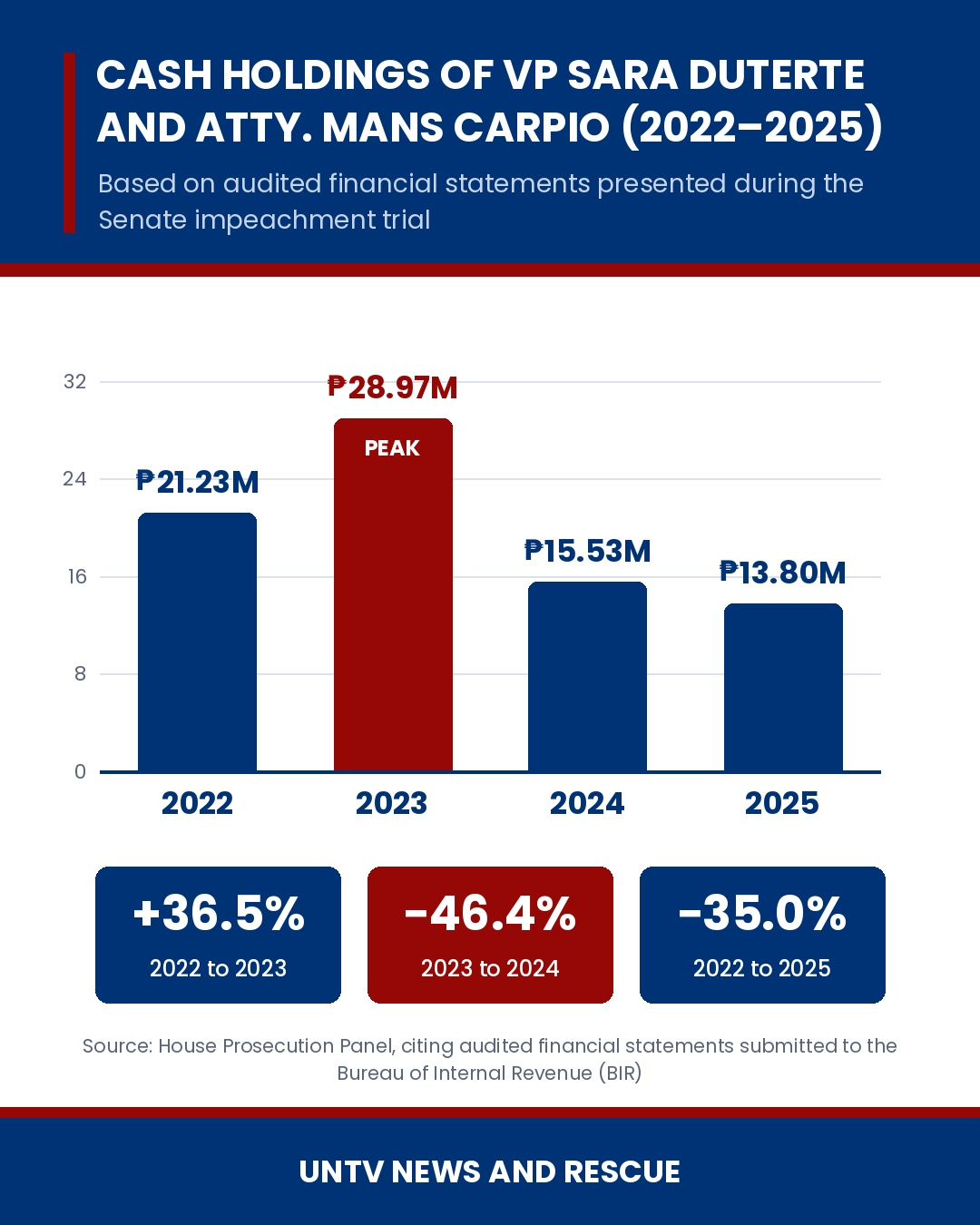
Barbers said Duterte's SALNs for the corresponding years did not contain separate entries identifying cash on hand or bank deposits.
He argued that the repeated absence of these entries supported the prosecution's allegation that material financial information had been intentionally withheld.
The figures represent reported holdings for individual years and should not be added together as though they were separate amounts of accumulated wealth.
Barbers maintained that the alleged discrepancies went beyond an isolated reporting mistake because the same issue appeared in multiple annual declarations.
He argued that an omission in a single year might be considered an error, but the absence of separately declared cash holdings from 2022 through 2025 raised questions about whether the information had been intentionally concealed.
The prosecution also highlighted Garcia-Marquez's testimony confirming that Duterte and Carpio signed declarations acknowledging responsibility for the information contained in their 2025 tax returns and accompanying financial statements.
Barbers said the documents provided a basis for questioning whether the Vice President had fully and accurately disclosed her financial assets as required of public officials.
Duterte's defense has previously explained that the cash holdings were included under the category of “other personal properties” in her SALNs rather than listed separately.
Defense spokesperson Atty. Michael Poa earlier maintained that the absence of a specific cash entry did not necessarily mean the assets had been excluded from the declarations.
The prosecution, however, disputed that explanation, arguing that the values reported under the category did not sufficiently reconcile with the financial records presented during the impeachment proceedings.
The defense has also challenged the prosecution's interpretation of the financial evidence and raised objections concerning the disclosure of confidential tax records during the trial.
The disputed financial records form part of Article II of the impeachment complaint against Duterte, which involves allegations of unexplained wealth and irregularities in her asset declarations.
Garcia-Marquez is scheduled to return to the Senate impeachment court on Friday, October 9, for the continuation of her cross-examination by the defense panel.
The prosecution's assertions of deliberate concealment remain allegations subject to examination and resolution by the Senate impeachment court. No final determination of liability has been made on this issue.
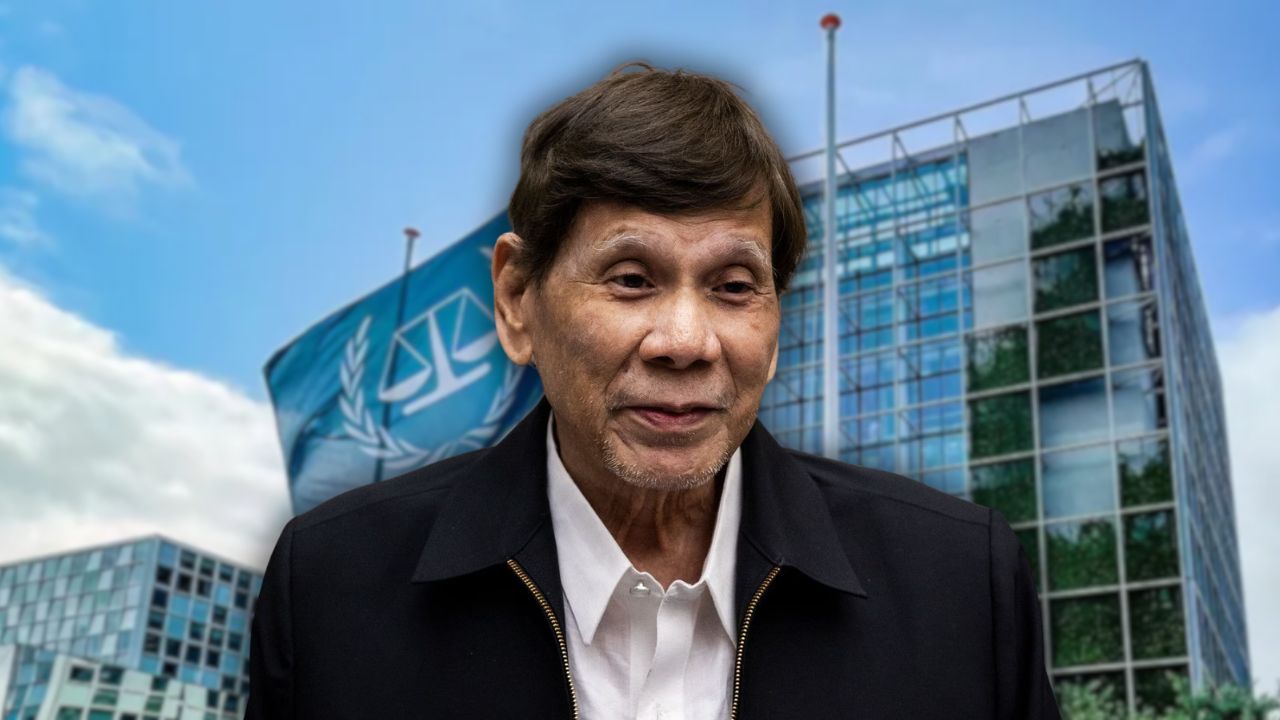
MANILA, Philippines – Former President Rodrigo Duterte has been declared fit to stand trial by the International Criminal Court (ICC), clearing a major procedural hurdle ahead of his scheduled trial for crimes against humanity on November 30, 2026.
In a decision made public on Thursday, October 8, ICC Trial Chamber III ruled that Duterte has sufficient capacity to understand the proceedings and participate meaningfully in his defense despite concerns previously raised about his health.
The ruling was originally issued on September 28, following an assessment by an independent panel of medical experts and a review of submissions from the parties involved in the case.
According to the ICC, the judges were satisfied that the former president could effectively exercise his rights to a fair trial.
The independent medical panel unanimously concluded that Duterte could understand the charges against him, recognize the purpose and potential consequences of the proceedings, and follow developments throughout the trial.
The experts also determined that he could comprehend the evidence presented, understand the implications of entering a plea, and communicate with his legal team to prepare and carry out his defense.
While the assessment acknowledged some age-related physical and cognitive slowing, the panel found that these limitations did not prevent Duterte from meaningfully participating in the proceedings.
The 81-year-old former president's defense team had previously raised concerns about his cognitive condition and argued that his health could affect his ability to stand trial.
However, after reviewing the medical findings and the parties' submissions, the chamber determined that the legal requirements for fitness to stand trial had been satisfied.
Despite the ruling, the ICC directed its Registry to continue monitoring Duterte's health throughout the proceedings.
The Registry must promptly inform the chamber of any significant changes in his condition that could affect his ability to participate in the trial.
The judges also adopted measures intended to facilitate Duterte's participation while protecting his procedural rights.
The determination of fitness to stand trial does not mean that Duterte has been found guilty. It establishes that he is capable of participating in the judicial proceedings and exercising his rights as an accused person.
Duterte faces three counts of crimes against humanity involving allegations of murder and attempted murder connected to killings during his administration's anti-illegal drug campaign and his earlier tenure as mayor of Davao City.
On April 23, 2026, ICC Pre-Trial Chamber I confirmed the charges against him, allowing the case to proceed to trial.
The former president was arrested in the Philippines in March 2025 and subsequently transferred to ICC custody in The Hague, Netherlands.
Duterte has denied the allegations against him, while his defense team has challenged the prosecution's case and previously sought to halt proceedings on medical grounds.
The trial is scheduled to open on November 30 before Trial Chamber III, composed of Presiding Judge Joanna Korner and Judges Keebong Paek and Nicolas Guillou.
Before the proceedings begin, the chamber is expected to address outstanding procedural matters and finalize arrangements to ensure the fair and orderly conduct of the trial.
The ICC's latest decision allows preparations for the scheduled hearing to move forward while Duterte's medical condition remains under observation.
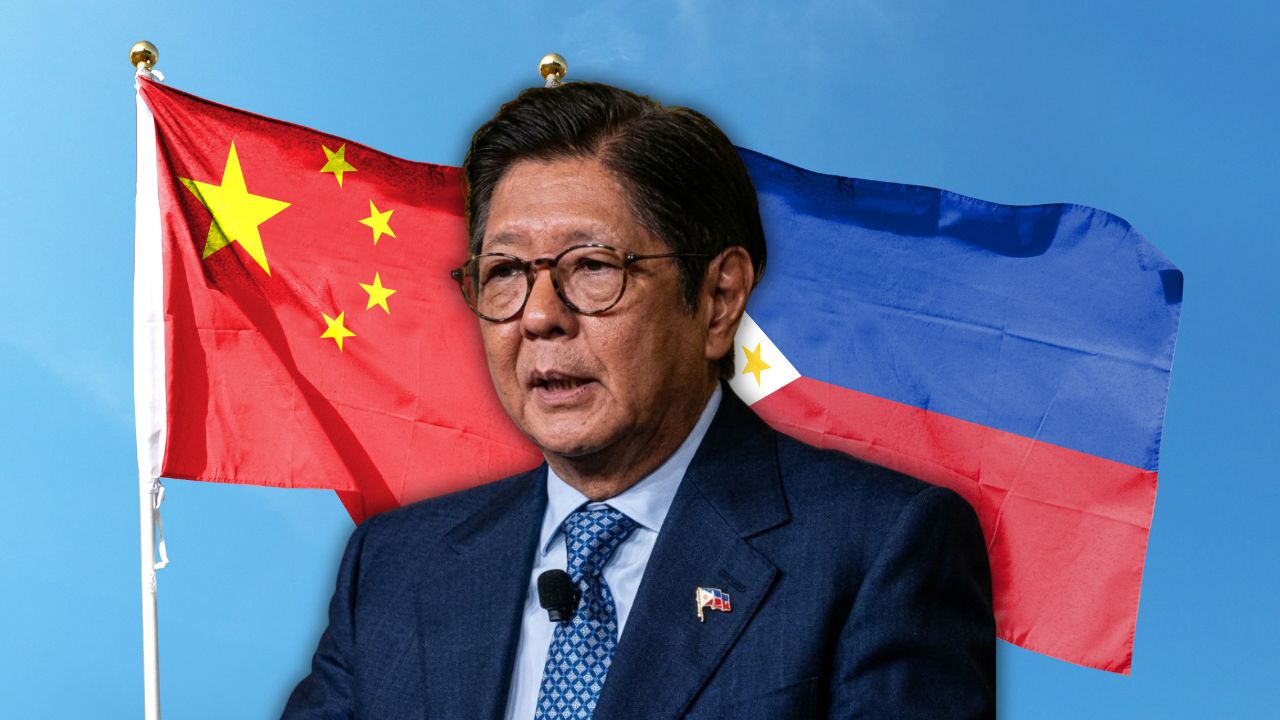
MANILA, Philippines — President Ferdinand Marcos Jr. has expressed optimism over ongoing negotiations between the Association of Southeast Asian Nations (ASEAN) and China for a Code of Conduct (COC) in the South China Sea, emphasizing the need to prevent maritime confrontations from escalating into armed conflict.
Speaking at the 24th Forbes Global CEO Conference in Singapore on Thursday, October 8, Marcos said discussions were making progress despite longstanding disagreements among the parties involved.
The President identified an unintended confrontation between military personnel or sailors as one of his greatest concerns, warning that even a single miscalculation could trigger a wider crisis.
"My greatest fear is that some seaman, some soldier, just makes a mistake. And that mistake turns into something that goes out of control," Marcos said.
He emphasized that establishing clear rules for conduct at sea is essential to reducing the risks of dangerous encounters and preventing misunderstandings between countries operating in disputed waters.
Negotiations advance despite disagreements
The proposed Code of Conduct seeks to establish guidelines governing the actions of countries in the South China Sea, where overlapping maritime claims have fueled tensions for decades.
ASEAN and China have been negotiating the agreement for years, following the adoption of the nonbinding Declaration on the Conduct of Parties in the South China Sea in 2002
While Marcos described the latest discussions as encouraging, he acknowledged that negotiators continue to face difficulties in reaching a consensus.
He noted that disagreements have extended even to the interpretation and definitions of ordinary words contained in the proposed agreement.
Despite these challenges, the President maintained that the Philippines and other ASEAN members remain committed to reaching an agreement that could help ease tensions in the region.
ASEAN and China are targeting the completion of negotiations by the end of 2026, although outstanding issues include the agreement's legal status, geographical coverage, and specific provisions.
Marcos also stressed that maintaining peace and freedom of navigation in the South China Sea is important not only to neighboring countries but also to international trade.
The waterway serves as a major route for global commerce, making regional stability a shared concern among countries that depend on maritime transportation.
Marcos reaffirms Philippine maritime rights
Beyond the negotiations, Marcos reiterated his administration's commitment to protecting the Philippines' territorial sovereignty and maritime entitlements in the West Philippine Sea.
He emphasized that defending the country's territory is part of his constitutional responsibility as President.
The Philippines' maritime rights in its exclusive economic zone are recognized under the United Nations Convention on the Law of the Sea (UNCLOS).
In 2016, an international arbitral tribunal ruled in favor of the Philippines in its maritime dispute with China, rejecting the legal basis for Beijing's claims to historic rights over resources within its expansive nine-dash line.
China has repeatedly rejected the ruling, maintaining its claims over large portions of the South China Sea.
Why the Philippines uses 'West Philippine Sea'
During the conference, Marcos also explained the country's use of the term West Philippine Sea to identify maritime areas west of the Philippine archipelago.
The President said the name reflects the Philippines' geographical position and reinforces its assertion of maritime rights in the area.
The Philippines formally adopted the designation through Administrative Order No. 29 in 2012.
The name refers to maritime areas on the western side of the Philippine archipelago, including the Luzon Sea and waters surrounding the Kalayaan Island Group and Bajo de Masinloc.
The designation does not replace the internationally recognized geographical name South China Sea for the entire body of water.
As ASEAN chair for 2026, the Philippines continues to push for the conclusion of the Code of Conduct negotiations before the end of the year.
Although an agreement has yet to be finalized, Marcos maintained that diplomatic engagement remains an important avenue for managing disputes, preventing accidental confrontations, and preserving stability in the region.
