


Emergency Hotline:
(+63) 2 911 – 8688



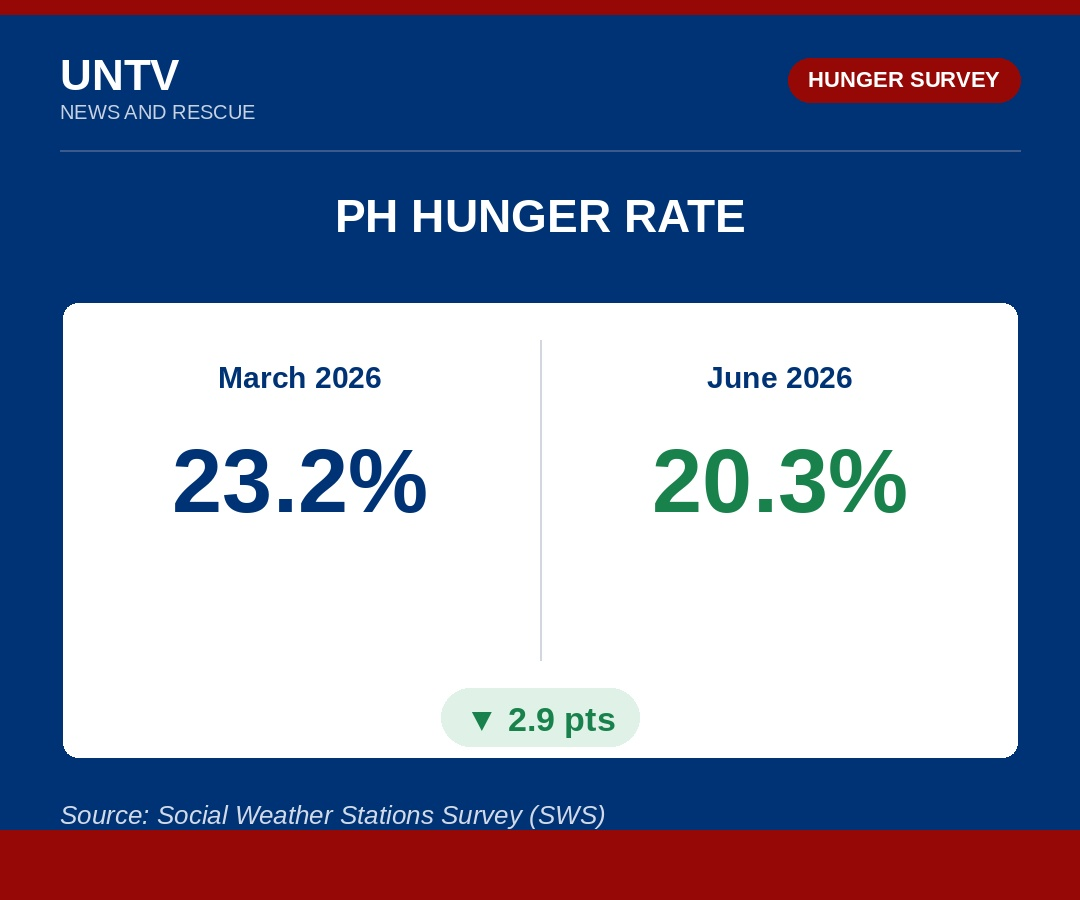
The country’s hunger rate declined to 20.3% in June 2026 from 23.2% in March, according to the latest survey by Social Weather Stations (SWS).
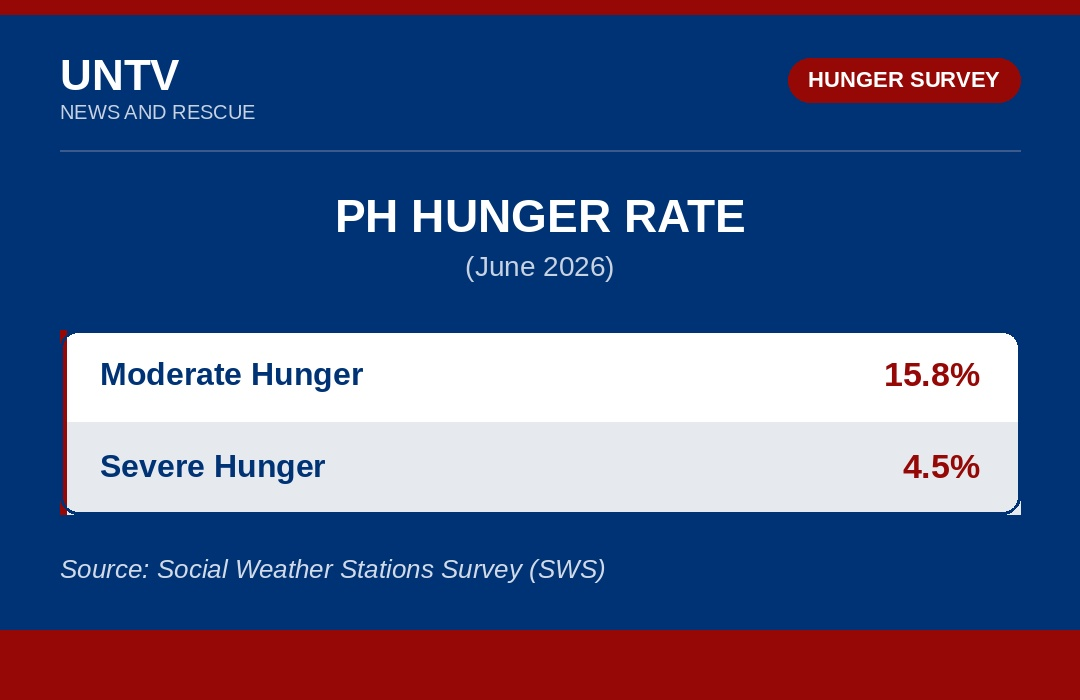
Of the 20.3% of respondents who reported experiencing hunger, 15.8% experienced moderate hunger, while 4.5% experienced severe hunger.
Mindanao recorded the highest incidence of hunger among the country’s major areas, followed by the Visayas, Metro Manila and Balance Luzon.
SWS conducted the survey from June 20 to 29 through face-to-face interviews with 1,200 respondents nationwide.
The latest results showed a 2.9-percentage-point decline in the national hunger rate compared with the previous survey in March.
The United States has warned countries and companies that continue doing business with Iran that they could face penalties as Washington intensifies its economic campaign against Tehran.
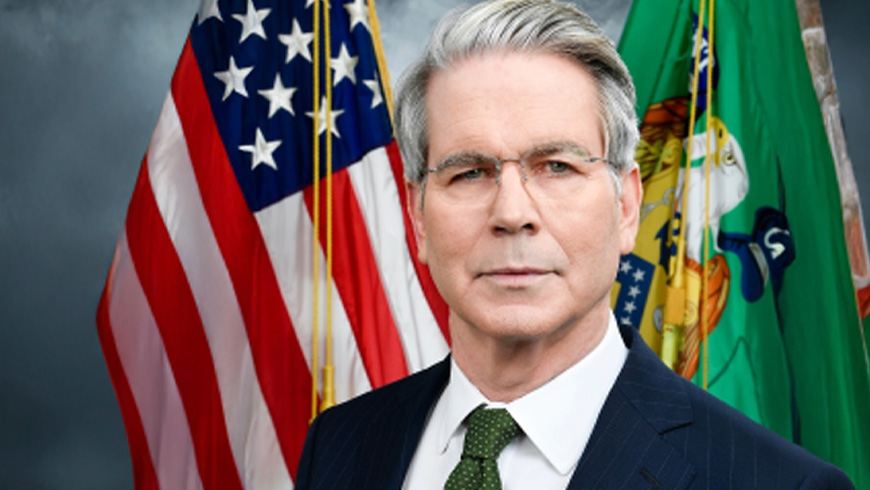
US Treasury Secretary Scott Bessent on Monday announced what the Trump administration calls “Operation Economic Outcast,” a new push aimed at cutting Iran off from its remaining financial and commercial links around the world. Bessent earlier described the campaign as an “economic D-Day” and the largest financial offensive Washington has mounted against an adversary.
The new measures are aimed at companies, financial institutions and other entities that help Iran generate revenue or evade existing US sanctions. Washington is also threatening secondary sanctions that could restrict foreign firms and governments from accessing the US financial system if they continue significant dealings with Tehran.
China is expected to be a major focus of the campaign because it remains the principal buyer of Iranian crude. Analysts say China’s continued purchases will be critical in determining how much pressure the new measures can exert on Tehran’s oil revenues.
Iran, however, rejected Washington’s latest pressure campaign and portrayed it as evidence that the United States had failed to force Tehran into submission through military means.
Iranian officials have argued that Washington’s decision to mobilize a wider range of economic tools contradicts US claims that Iran’s military and nuclear capabilities have already been severely weakened.
Tehran has also warned governments against joining the US sanctions campaign. Iranian officials said countries that cooperate with the measures could face retaliation, further raising the risk of a broader economic confrontation.
The pressure comes as Iran’s economy continues to deteriorate after months of war, sanctions and disruptions to its oil trade. The Iranian rial fell to a new record low this week, while inflation and rising prices have further strained household finances.
Despite the growing pressure, Iran still holds leverage through the Strait of Hormuz, one of the world’s most important energy routes.
Iran’s newly established Persian Gulf Strait Authority has blacklisted 45 tankers for allegedly violating its transit rules and warned that the vessels could face fines, detention or confiscation of cargo. Tehran has also maintained that reopening the waterway on broader terms would require concessions from Washington, including the lifting of the US naval blockade and oil sanctions.
Inside Iran, the worsening economic situation has also fueled debate over how long Tehran can sustain the confrontation.
Iranian President Masoud Pezeshkian recently said the war would eventually have to end and suggested it would be better to reach that point sooner rather than later. Parliament Speaker Mohammad Bagher Ghalibaf has likewise warned that military strength alone would not be enough if economic hardship continued to deepen and ordinary Iranians remained under pressure.
At the same time, regional governments are continuing efforts to bring Washington and Tehran back to negotiations.
Pakistan, Oman and Qatar have remained involved in diplomatic efforts to reopen dialogue, with officials describing a negotiated settlement as the preferred way out of the conflict. Direct US-Iran talks, however, remain stalled.
For now, the confrontation is increasingly shifting toward economic pressure, with Washington seeking to isolate Iran and Tehran warning that countries helping enforce the sanctions could face consequences of their own.
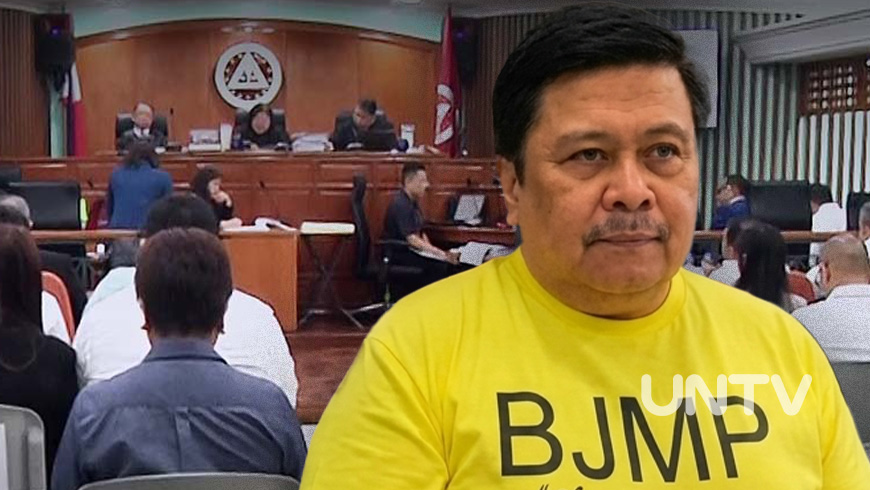
The Sandiganbayan has allowed detained Sen. Jinggoy Estrada to temporarily leave the New Quezon City Jail to undergo an X-ray procedure on both knees at a private hospital in San Juan City on Wednesday, August 26.
In a resolution, the anti-graft court’s Fifth Division granted Estrada’s request for medical leave after he cited persistent pain in both knees and a previous diagnosis of osteoarthritis, a condition that has made walking difficult for him.
Estrada said his orthopedic doctor recommended an X-ray of both knees to determine whether his condition had worsened. The procedure is expected to take about 15 to 30 minutes.
The prosecution opposed the request, arguing that Estrada’s reported condition was not based on a direct clinical assessment or independently verified medical findings. State prosecutors also suggested alternatives, including the use of a mobile X-ray service at the detention facility or an examination at a government-run medical facility.
The Sandiganbayan nevertheless granted the request subject to conditions.
Estrada will be allowed to leave the detention facility at 11 a.m. on August 26 and must be returned by 3 p.m. the same day. The court also ordered him to shoulder all hospital, transportation and incidental expenses related to the procedure.
Estrada is currently detained at the New Quezon City Jail in Payatas in connection with a plunder case stemming from alleged irregularities in flood control projects.
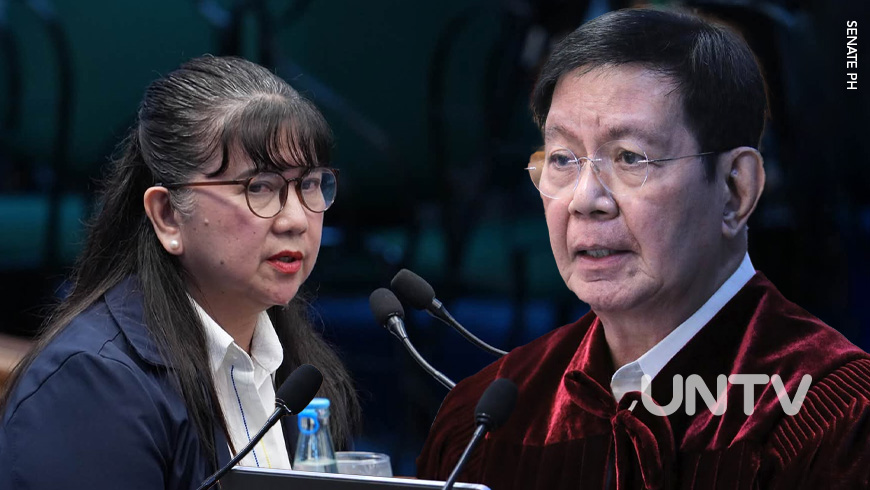
Manila, Philippines – Several senator-judges expressed frustration over the repeated answers of former Office of the Vice President special disbursing officer Gina Acosta as she faced further questioning on the handling of the OVP’s confidential funds.
Senator-judge Panfilo Lacson pressed Acosta over how the funds were released and accounted for, questioning whether her role as special disbursing officer was merely ministerial or whether she exercised judgment before approving transactions.
Lacson noted that even if the funds were intended for confidential activities, purchases and disbursements still had to be supported by proper documentation, including official receipts and signatures from actual recipients.
After repeatedly asking Acosta to clarify her role, Lacson said he was unable to get a direct answer.
“Tapos na oras ko. Sige, maraming salamat. Wala akong makitang sagot,” Lacson said as his allotted questioning time ended.
Senator-judge Vicente “Tito” Sotto III also expressed frustration after Acosta again referred to Col. Raymund Dante Lachica as the OVP’s designated security officer and the person tasked with confidential operations.
Sotto questioned whether Lachica could have personally handled operations covering 132 areas in just 11 days.
When Acosta again explained Lachica’s designation and role in the Vice Presidential Security and Protection Group, Sotto responded that he no longer wanted to hear what he described as a “template” answer.
Acosta, meanwhile, confirmed during questioning by Senate President Sherwin Gatchalian that Vice President Sara Duterte instructed her to release the P125 million in confidential funds to Lachica after the money was encashed.
Asked who instructed her to encash the P125 million, Acosta said it was the Vice President so that the money could be turned over to the security officer.
She clarified that Duterte told her that once the funds were encashed, they should be released to Lachica.
Senator-judge Raffy Tulfo also criticized Acosta for relying on Lachica despite questions surrounding the acknowledgment receipts submitted to support the confidential fund expenses.
Tulfo described Acosta’s actions as “stupid in the name of blind loyalty,” suggesting that she followed instructions without sufficiently questioning the transactions.
Acosta responded that she did not understand the characterization.
The exchanges came as the impeachment court continued scrutinizing how the OVP’s confidential funds were released, spent and liquidated, as well as the roles played by Acosta, Lachica and other officials in the transactions.
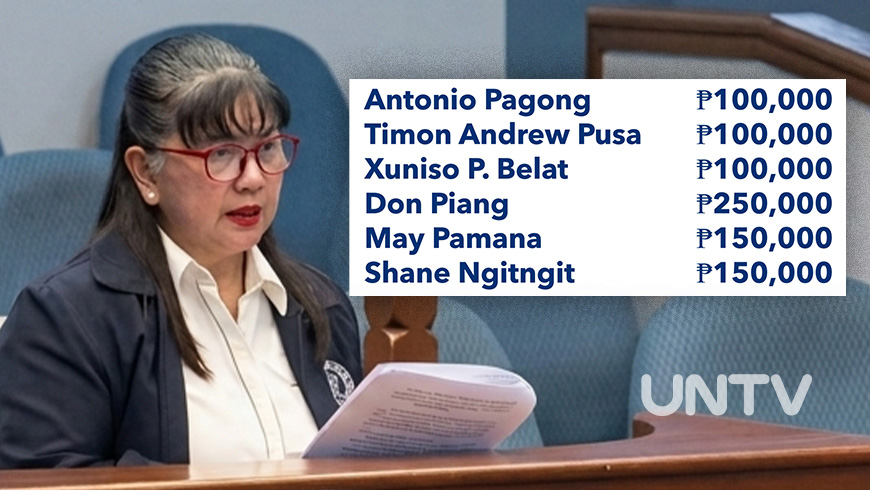
More unusual names surfaced in acknowledgment receipts submitted to account for the Office of the Vice President’s confidential fund expenditures during Vice President Sara Duterte’s impeachment trial.
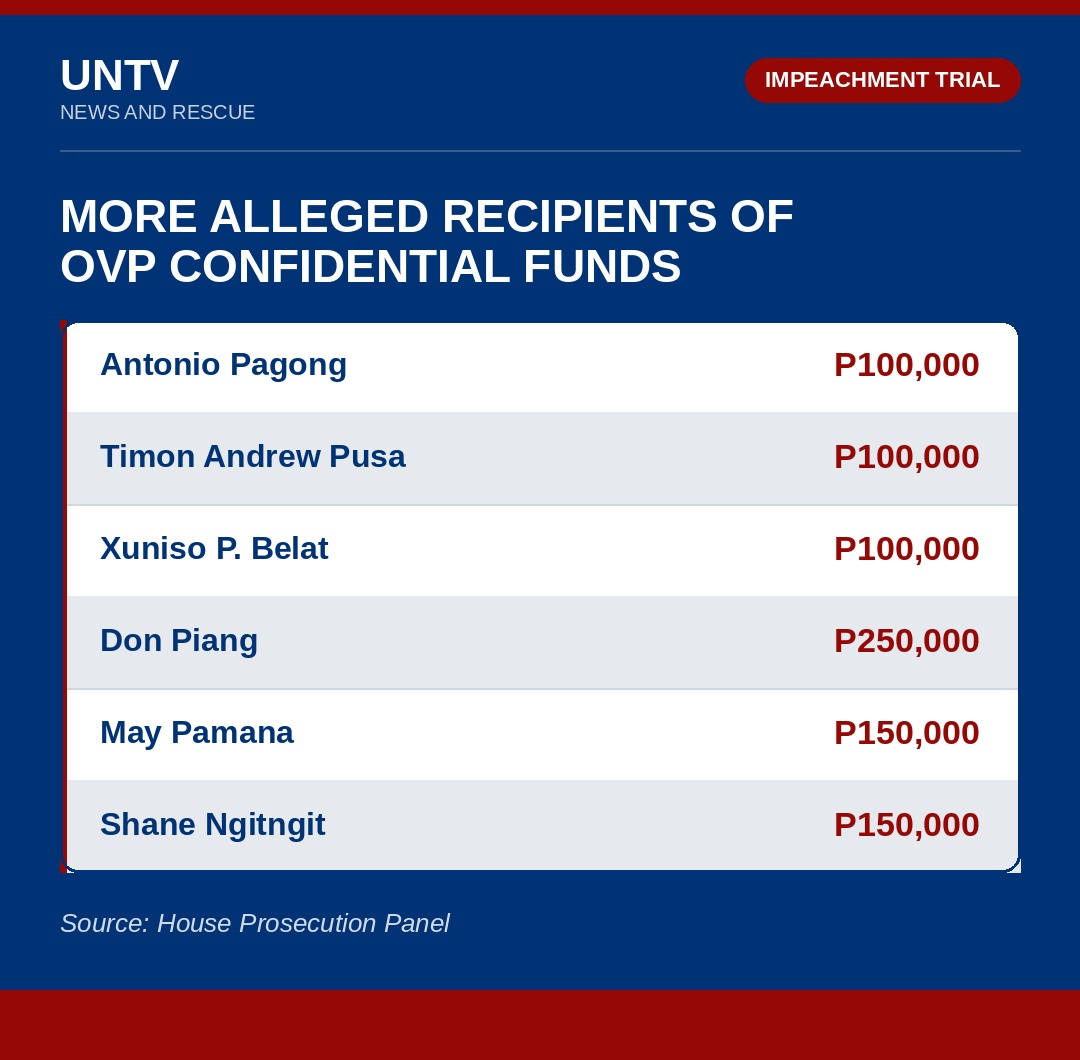
Among the names presented by the prosecution were Antonio Pagong, Timon Andrew Pusa, Xuniso P. Belat, Don Piang, May Pamana and Shane Ngitngit.
The receipts showed that Pagong, Pusa and Belat purportedly received P100,000 each. Piang was listed as receiving P250,000, while Pamana and Ngitngit were associated with P150,000 each. The stated purposes included the purchase of information, transportation and supplies for confidential operations.
Former OVP special disbursing officer Gina Acosta, however, admitted that she did not personally witness Col. Raymund Dante Lachica hand the money to the individuals named in the receipts.
Asked by private prosecutor Amando Ligutan whether she saw Lachica give P100,000 to Antonio Pagong, Acosta said she was not present during the transactions.
“Hindi ko siya nakita, Your Honor, kasi wala po ako doon sa ground. Siya po ang nag-implement,” Acosta told the impeachment court.
Acosta said her role was to release the confidential funds to Lachica, who was tasked with carrying out confidential operations. She said she relied on the documents submitted by Lachica in accounting for the funds because she was not personally involved in the operations on the ground.
The use of the surname “Lapid” in some acknowledgment receipts also drew questions from senator-judge Lito Lapid.
Lapid raised concern over whether the names appearing in the documents belonged to actual individuals or were merely aliases, noting that his own surname appeared among the recipients.
Acosta responded that the documents came from Lachica, who had been designated as the OVP security officer and tasked with implementing confidential operations.
Other names bearing the surnames Lapid and Hontiveros also appeared in acknowledgment receipts presented during the hearing.
The receipts are being scrutinized as the impeachment court examines how the OVP accounted for its confidential funds and whether the supporting documents sufficiently established how the money was spent.
