


Emergency Hotline:
(+63) 2 911 – 8688


When the price of almost everything goes up at once, people start looking at their daily habits differently. Rising fuel prices, higher electricity bills, and more expensive goods at the market — this is the reality many Filipinos are waking up to every day, and the pressure to find ways to stretch every peso has never been more urgent.
Interestingly, some Filipinos have managed to cut their transportation costs down to almost nothing — not through any special trick, but because they traded their commute for a walk or a run. For many, the shift started long before the price hikes, driven by a desire to get fit or live more actively. What they did not know then was that they were also quietly preparing themselves for exactly this kind of economic pressure.
Walking or running to your destination means zero fuel cost, zero fare, and zero parking fee. For anyone covering short to medium distances daily, those savings add up to hundreds of pesos a month — money that could go toward groceries, bills, or whatever the budget is currently short on.
And the financial relief does not stop at transportation. Less driving also means less wear and tear on vehicles, lower maintenance costs, and a smaller carbon footprint to boot.
But conservation goes beyond transportation. The same principle applies to electricity, water, and even food.
Turning off lights in empty rooms, unplugging appliances on standby, and reducing unnecessary energy use at home can meaningfully cut monthly bills, a relief that matters when inflation is chipping away at purchasing power from every direction.
The shift in habits is also being driven by policy. The government's adoption of a compressed workweek and work-from-home arrangements has already shown measurable results — the Department of Energy reported that agencies observing these practices managed to cut energy consumption by more than 10 percent. Fewer working days in the office means fewer commutes, less fuel burned, and lower demand on the power grid. It is a small structural change with a surprisingly large ripple effect.
At the same time, commuters who still rely on public transportation are feeling the squeeze from another direction. The Land Transportation Franchising and Regulatory Board (LTFRB) has approved fare increases for PUVs today, adding yet another layer of financial pressure on daily commuters.
For many, the math is becoming harder to ignore when fares go up and fuel prices follow, choosing to walk or run to work stops being a lifestyle option and starts being a practical necessity.
Experts have long said that the best buffer against an energy crisis is not just supply, it is demand management. When people consume less, prices stabilize more easily.
When communities adopt conservation as a norm rather than a last resort, the economy becomes more resilient from the ground up. The Department of Energy has already seen this in action, and the ripple effect of collective, conscious effort is real.
The people who saw this coming and adjusted early did not just save money. They built a habit that will serve them long after prices eventually settle.
For everyone else, the window to start is still open, and with fares rising, fuel prices climbing, and the cost of daily life showing no signs of easing, there has never been a better time to put on a pair of sneakers and head out the door.

United States President Donald Trump said the American military operation dubbed "Epic Fury" is projected to last four to five weeks, with the possibility of extending further if necessary.
The operation aims to halt the development of Iran's nuclear and ballistic missile programs and dismantle its capabilities, which the US considers a threat to its security and that of its allies.
Trump said his administration had planned for this timeline from the start.
"Whatever it takes — we projected four to five weeks, but we have the capability to go far longer than that," he said.
The US president described the strikes as a long-planned strategic decision, calling it the last window to act against the Iranian regime.
"This was our last best chance to strike and eliminate the intolerable threats posed by this sick and sinister regime," Trump said.
He outlined the key objectives of the operation, which include destroying Iran's missile capabilities, cutting off its support for militant groups, and ensuring it cannot develop a nuclear weapon.
"Our objectives are clear. First, we're destroying Iran's missile capabilities," he said.
Trump also acknowledged that American service personnel have been killed in the course of the operation. Despite this, he said the United States is resolved to press on.
"In their memory, we continue this mission with ferocious, unyielding resolve to crush the threat this terrorist regime poses to the American people," the US president said.

Vice President Sara Duterte filed a perjury complaint today against Ramil Madriaga, the man who allegedly identified himself as her bagman.
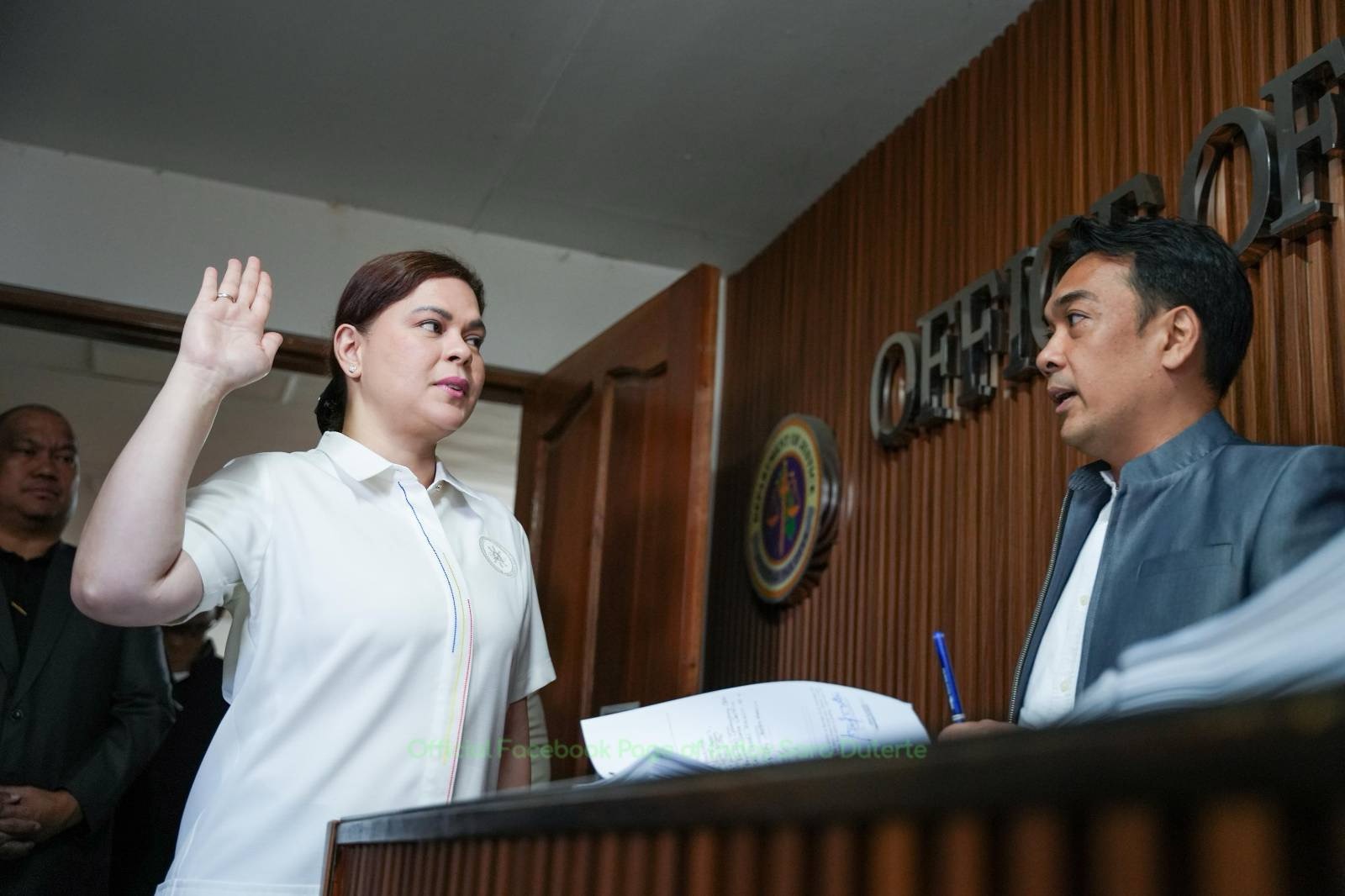
The filing comes after Madriaga claimed in an affidavit submitted to the Office of the Ombudsman that he had delivered large sums of money to various individuals under Duterte’s instructions, a claim the Vice President strongly denied.
In an official statement, the Vice President said she wants to hold Madriaga accountable for his lies.
Duterte stressed that she will not allow fabricated stories to be used to deceive the public.

MANILA – Mamamayang Liberal party-list Rep. Leila De Lima was named the new House senior deputy minority leader on Tuesday, replacing Caloocan City Rep. Edgar Erice.
House Minority Leader Marcelino Libanan moved to replace Erice and nominate De Lima during the regular House session. The motion was joined by the majority bloc, as manifested by House Deputy Majority Leader Ronald Singson of Ilocos Sur.
The leadership change came on the same day that Erice publicly criticized President Ferdinand Marcos Jr. and his allies in the House for what he described as taking the public for a ride over the Anti-Political Dynasty bill, which he said was being falsely presented as a legislative priority.

MANILA – President Ferdinand R. Marcos Jr. on March 3 welcomed South Korean President Lee Jae Myung at Malacañang Palace for a two-day state visit focused on strengthening bilateral ties in defense, maritime security, and economic relations.
Marcos and FL Liza Marcos accorded arrival honors to Lee at the Kalayaan Grounds. The South Korean leader was accompanied by First Lady Kim Hea Kyung.

The visit marks the first by a South Korean head of state to the Philippines since the Philippines-Republic of Korea Free Trade Agreement took effect on December 31, 2024.
Following the welcome ceremony, Lee signed the Palace guestbook before proceeding to a bilateral meeting with Marcos. Key Cabinet members joined the Philippine side, including Trade Secretary Cristina Aldeguer-Roque, Finance Secretary Frederick Go, Economic Planning Secretary Arsenio Balisacan, Interior Secretary Juanito Victor Remulla, Executive Secretary Ralph Recto, Education Secretary Sonny Angara, Agriculture Secretary Francisco Tiu-Laurel Jr., National Security Adviser Eduardo Año, and Presidential Communications Secretary Dave Gomez.
The two leaders are expected to discuss enhanced collaboration in defense and maritime security amid evolving regional and global security dynamics, as well as the broader implications of rising Middle East tensions on energy markets and supply chains.
After the bilateral talks, Marcos and Lee are scheduled to deliver a joint press statement and witness the signing and exchange of agreements between the two governments.
Milestone visit
Lee's state visit coincides with the 77th anniversary of the establishment of diplomatic relations between the Philippines and South Korea, which dates back to March 1949.
The two countries have elevated their ties to a strategic partnership in recent years, with cooperation spanning trade, infrastructure, energy, shipbuilding, and defense modernization.
Marcos and Lee last met on the sidelines of the Asia-Pacific Economic Cooperation Summit, which South Korea hosted in Gyeongju in October last year.
Lee arrived in the Philippines following a visit to Singapore. Upon arrival Tuesday, he paid tribute to Philippine national hero Dr. Jose Rizal at Luneta Park in Manila.
